Web · 15-10-2026 · Agastheeswarar Trust | PDF · 13-10-2026
The Panchabootham Earth System Model (PESM) is the Trust’s integrated research-and-action framework, rooted in the Panchabootham tradition. It draws on Panchabootham as a traditional integrative lens and uses scientific data and field measurements to examine resource use, environmental conditions and community wellbeing. It complements government programmes and the SDGs by following effects across sectors and scales. Our application is being refined through continuing study and interpretation of traditional verses, scientific evidence and field measurements. Practical projects and transparent evaluation are central to this work.
Panchabootham offers a traditional way to understand our relationship with nature. PESM brings this perspective into a framework for examining water, soil, heat, air, ecological capacity, living beings and human choices together. Our aim is to support wellbeing while reducing pressure on resources.
Global evidence explains why action matters. The UN SDG Report 2026 finds 15% of 139 assessed targets on track and 21% making moderate progress. Planetary Health Check 2026 reports seven of nine boundaries transgressed. WWF’s Living Planet Report 2024 reports a 73% average decline in monitored vertebrate population sizes during 1970–2020, not a count of all animals lost. Global Footprint Network estimates demand equivalent to 1.73 Earths in 2026, with Earth Overshoot Day on 30 July. This ecological-footprint measure is not a measure of every mineral, fossil fuel or freshwater stock.
We distinguish releases such as smoke and wastewater, depletion of stores such as groundwater and materials, and structural changes such as land conversion. Each calls for different action: emission limits, resource budgets or protection of shared land and habitat. Restraint, fair sharing and restoration connect these actions.
We plan to develop and evaluate this approach with partner villages in Tamil Nadu, beginning with the proposed Panchetti tank project. Field implementation and comparison studies are planned; results will be published as they become available.
The baseline connects five element domains, living beings and human choices across household, village and wider scales. Panchikaranam provides a traditional structural prior: 50% of its own element and 12.5% of each other element. These are not measured material fractions. The weakest-indicator rule is a scoring assumption to evaluate. Akasha retains its traditional meaning; capacity and habitat are practical indicators, not a scientific definition of Akasha.
For the proposed pilot, we plan baseline measurements and comparison villages over two monsoons. Indicators include water levels and quality, tank storage, tree survival, heat, air, waste and resource use. We will specify questions and methods in advance, account for rainfall and local differences, seek independent review and publish findings and limitations. Household wellbeing observations will require consent.
The Panchabootham Earth System Model (PESM) is the Trust’s integrated research-and-action framework, rooted in the Panchabootham tradition. It draws on Panchabootham as a traditional integrative lens and uses scientific data and field measurements to examine resource use, environmental conditions and community wellbeing. It complements government programmes and the SDGs by following effects across sectors and scales.
We plan to develop and evaluate this approach with partner villages in Tamil Nadu, beginning with the proposed Panchetti tank project. Field implementation and comparison studies are planned; results will be published as they become available. Our application is being refined through continuing study and interpretation of traditional verses, scientific evidence and field measurements. Practical projects and transparent evaluation are central to this work. admin@agastheeswarartrust.org
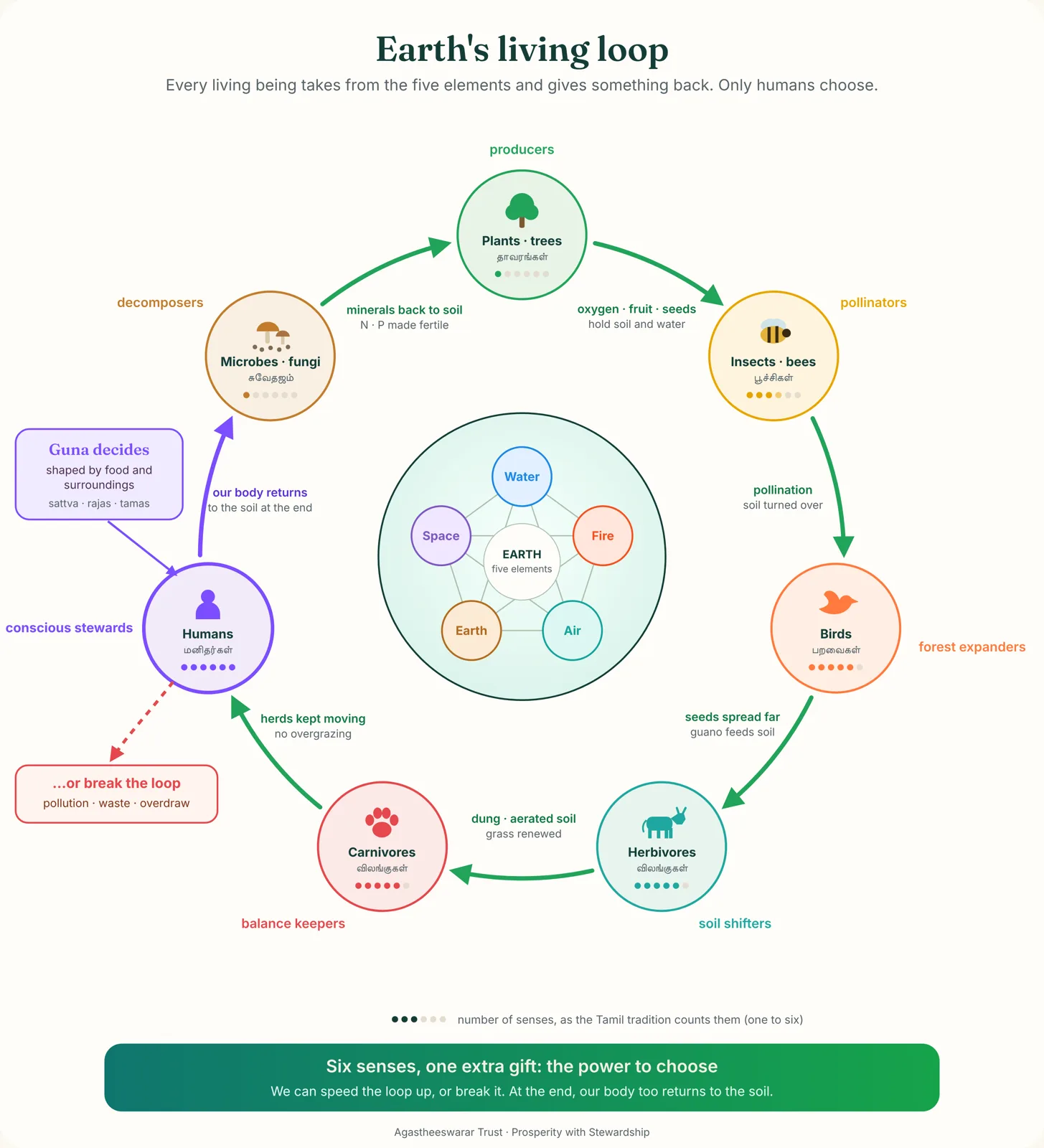
Earth’s living loop, group by group
Traditional interpretation: the element and body associations illustrate the Trust’s reading of Siddha sources. They are not measured physical compositions or modern anatomical classifications.
| Group | Senses · Tamil term | Takes from Earth | Role | Gives back |
|---|---|---|---|---|
| Microbes · fungi | 1 · சுவேதஜம் | Dead leaves, carcasses, waste | Decomposers: break complex matter down | Minerals, nitrogen and phosphorus back to the soil |
| Plants · trees | 1 · தாவரங்கள் | Sun’s heat, groundwater, air, soil nutrients | Producers: turn the elements into living food | Oxygen, fruit, seeds; hold soil and moisture |
| Insects · bees | 3–4 · பூச்சிகள் | Nectar, sap, pollen, detritus | Pollinators and soil aerators | Pollination for about 80% of plants; ants and termites recycle tough plant matter |
| Birds | 5 · பறவைகள் | Wild fruit, seeds, insects, fish | Forest expanders | Seeds dropped far and ready to sprout, with rich droppings as fertiliser |
| Herbivores | 5 · விலங்குகள் | Grass, leaves, bark, water | Soil shifters: graze, roam, churn the ground | Dung that feeds earthworms and beetles, and loosens the soil |
| Carnivores | 5 · விலங்குகள் | Herbivores | Balance keepers | Keep herds moving, so grassland, riverbanks and forest recover |
| Humans | 6 · மனிதர்கள் | Something from every group above | Conscious stewards (பகுத்தறிவு): can speed the loop up or break it | At the end, the body returns to the soil and the loop goes on |